Explore key tools, smart features, and expert insights...
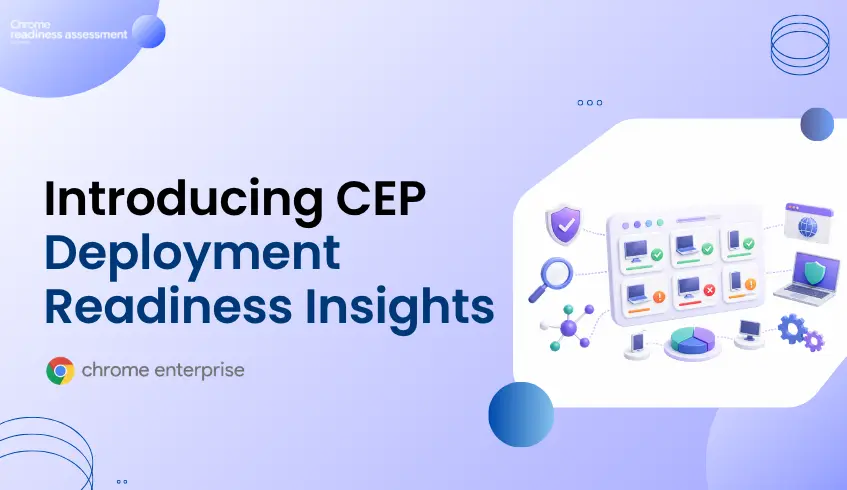
Rolling out Chrome Enterprise Premium across an enterprise fleet requires more than turning on a security product. It depends on whether devices, browsers, policies, networks, hardware, and legacy environments are ready to support deployment. CEP Deployment Readiness Insights helps IT and security teams identify rollout blockers before deployment begins, so they can plan with more confidence and fewer surprises.
This new readiness capability gives organizations a centralized view of deployment readiness across the fleet. It highlights which devices are ready, which devices need attention, and which risks may slow down or prevent a successful Chrome Enterprise Premium rollout.
Chrome Enterprise Premium helps organizations bring advanced browser security closer to where work happens. Google describes Chrome Enterprise Premium as a secure enterprise browsing solution that enhances Chrome’s built-in security with capabilities such as configurable data loss prevention, real-time phishing and malware protection, sandboxing protection, and secure access controls.
But before organizations can fully benefit from Chrome Enterprise Premium, they need to understand whether their environment is ready for deployment.
That is where many enterprise teams run into friction.
A large organization may have thousands of devices across departments, domains, operating systems, browser versions, user groups, and network environments. Some devices may be fully prepared for rollout. Others may have outdated operating systems, hardware limitations, policy conflicts, identity dependencies, network restrictions, or browser management gaps.
Without a readiness view, these issues are often discovered after deployment has already started. That can lead to delayed timelines, inconsistent rollout experiences, increased troubleshooting, and uncertainty across IT and security teams.
CEP Deployment Readiness Insights is designed to solve that problem before rollout begins.
CEP Deployment Readiness Insights is a pre-deployment visibility feature within the Chrome Readiness Assessment experience. It helps organizations assess whether their endpoint environment is ready for Chrome Enterprise Premium deployment.
Instead of showing only raw endpoint information, the feature organizes readiness signals into clear, actionable insights. Administrators can see overall deployment posture, identify devices with blockers, review the most common readiness issues, and investigate device-level details when needed.
The goal is simple: help teams understand what could block or slow CEP deployment before they begin or expand rollout.
The feature begins with a CEP Pre-Deployment Check option in the configuration wizard.
When administrators enable this option, the assessment collects and evaluates the readiness signals needed to understand CEP deployment posture. Once enabled, CEP Deployment Readiness Insights become available in the Dashboard and Report Generator.
This keeps the experience intentional. Readiness insights appear only when the organization has configured the assessment to evaluate CEP deployment readiness.
For IT teams, this means the readiness workflow can be aligned with an actual deployment planning process. For security teams, it creates a structured way to understand rollout exposure before Chrome Enterprise Premium adoption expands.
The Dashboard provides an organization-level view of CEP deployment readiness.
Administrators can quickly see the overall state of the fleet, including total device count, devices ready for deployment, devices with deployment blockers, performance risks, and migration risks.
This matters because enterprise rollout planning often starts with a basic question: how ready are we?
The Dashboard helps answer that question at a glance. Instead of manually comparing device inventories, policy exports, network checks, and support data, teams get a centralized readiness summary that highlights where rollout may proceed smoothly and where attention is needed.
The Dashboard also surfaces top deployment blockers across the device fleet. This helps teams identify repeated issues that may affect many users or departments, rather than investigating one device at a time.
CEP Deployment Readiness Insights groups readiness checks into clear categories so administrators can understand the type of issue affecting deployment.
The readiness categories include:
OS & Hardware Compatibility This category helps identify device conditions that may affect whether an endpoint can support rollout successfully. It gives teams visibility into compatibility concerns before they create deployment friction.
Network & Connectivity Health This category highlights network and connectivity conditions that may affect access, service reachability, or rollout behavior. For distributed workforces and hybrid environments, this is especially important.
Migration Friction & Legacy Dependencies This category helps teams understand whether older systems, dependencies, or environment conditions may slow migration or create rollout complexity.
Policy Conflict & Operational Health This category identifies policy-related or operational conditions that may interfere with a smooth deployment experience.
By grouping readiness issues this way, the feature helps administrators move faster from “something is wrong” to “this is the kind of issue we need to investigate.”
Not every readiness issue has the same impact.
CEP Deployment Readiness Insights classifies blockers into two practical severity levels: Hard Blockers and Soft Blockers.
Hard Blockers represent critical conditions that may prevent successful CEP deployment on a device. These are the issues teams should prioritize first because they can directly affect rollout feasibility.
Soft Blockers represent reviewable risks that may affect rollout quality, performance, policy behavior, or user experience. These issues may not always stop deployment completely, but they should be reviewed and addressed before broader rollout.
This classification helps teams prioritize. Instead of treating every readiness issue as equally urgent, administrators can focus on the conditions most likely to disrupt deployment.
Organization-level visibility is useful, but deployment teams also need to understand what is happening on individual devices.
CEP Deployment Readiness Insights provides device-level readiness status and blocker reasons. Administrators can review which devices are ready, which devices are blocked or at risk, and what readiness category each issue belongs to.
For each readiness check, the experience can show details such as the check name, detected value, failing threshold, blocker type, and readiness status.
This helps reduce manual investigation. Instead of exporting multiple reports or asking endpoint teams to validate conditions one by one, administrators can see why a device is considered ready, blocked, or at risk.
Large enterprise environments need more than a static report. They need ways to narrow the data quickly.
CEP Deployment Readiness Insights supports search and filtering for device-level investigation. Administrators can filter readiness data by device, UUID, group, domain, and readiness status where applicable.
This helps teams investigate specific parts of the organization. For example, an administrator may want to review readiness for a particular department, domain, or group before scheduling rollout. They may also want to find devices with a specific readiness status so remediation can be prioritized.
For enterprise-scale deployments, this kind of filtering is critical. It keeps the readiness experience usable even when the fleet includes thousands of devices across multiple business units.
The Report Generator includes the CEP Pre-Deployment Readiness section when the feature is enabled.
This gives teams a structured way to review readiness outside the Dashboard. Reports can support rollout planning, stakeholder communication, remediation tracking, and internal decision-making.
The Dashboard is useful for quick visibility. The Report Generator is useful when teams need a more detailed readiness view that can be shared, reviewed, or used during deployment planning discussions.
Together, they give organizations both high-level visibility and detailed readiness context.
CEP Deployment Readiness Insights is built to help organizations move from reactive troubleshooting to proactive deployment planning.
Teams should expect better visibility into which devices are ready for CEP deployment, faster identification of blockers and risk areas, clearer prioritization of devices that need attention, and more structured readiness reporting through the Dashboard and Report Generator.
Just as important, teams should understand what this feature is not intended to do.
CEP Deployment Readiness Insights does not automatically deploy Chrome Enterprise Premium. It does not automatically fix detected blockers, replace endpoint management tools, apply remediation without administrator review, or provide continuous live monitoring after the readiness report is generated.
Its purpose is pre-deployment visibility.
That distinction makes the feature valuable for planning. It helps administrators understand readiness gaps before rollout begins, so they can take informed action using the right operational and security processes.
Chrome Enterprise Premium can help organizations strengthen browser security with advanced protections for data, threats, and access. Google’s Chrome Enterprise Premium documentation describes capabilities such as DLP controls, malware and phishing protection, sandboxing protection, and context-aware access for enterprise environments.
CEP Deployment Readiness Insights helps organizations prepare for that adoption more effectively.
It gives IT and security teams a clearer understanding of rollout feasibility before deployment begins. It helps identify device populations that are ready to move forward. It highlights the blockers that need attention. And it supports a more confident, phased approach to Chrome Enterprise Premium rollout.
For organizations managing complex endpoint fleets, that visibility can make the difference between a reactive deployment and a planned deployment.
CEP Deployment Readiness Insights is a pre-deployment readiness feature that helps organizations assess whether their devices and environments are ready for Chrome Enterprise Premium rollout.
When enabled through the CEP Pre-Deployment Check, readiness insights appear in the Dashboard and Report Generator.
It shows readiness issues across OS and hardware compatibility, network and connectivity health, migration friction and legacy dependencies, and policy conflict and operational health.
A Hard Blocker is a critical issue that may prevent successful deployment. A Soft Blocker is a reviewable issue that may affect rollout quality, performance, or policy behavior but can usually be addressed before deployment.
No. CEP Deployment Readiness Insights is focused on visibility and planning. Administrators remain responsible for reviewing and addressing blockers through the appropriate operational processes.
Before rolling out Chrome Enterprise Premium across your enterprise fleet, understand what could block deployment.
Use CEP Deployment Readiness Insights to assess readiness, identify blockers, prioritize investigation, and plan Chrome Enterprise Premium adoption with greater confidence.
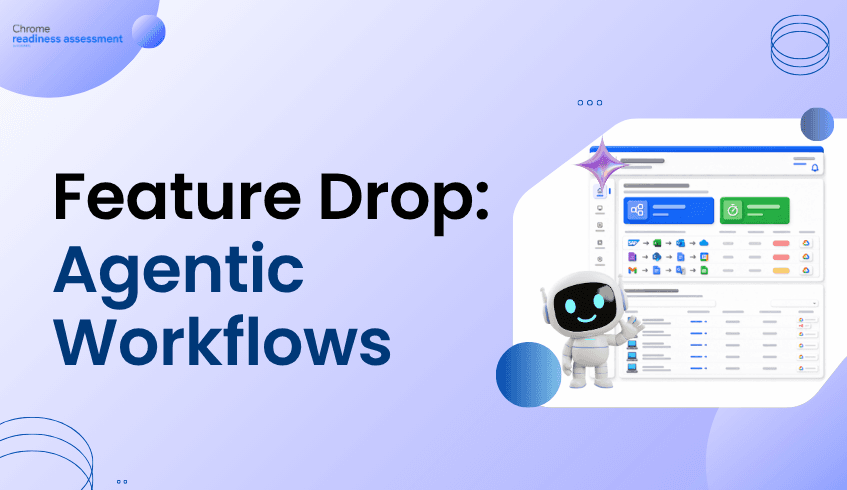
Agentic AI is creating a new opportunity for enterprises to reduce repetitive work, but most teams still face a practical first question: which workflows should be automated first? Agentic Workflows helps answer that question by identifying repetitive, multi-step workflows across applications, devices, and browser-based activity. The feature gives IT and operations teams visibility into workflow patterns, time spent, device-level usage, and automation readiness. Instead of guessing where automation may help, organizations can start with real workflow evidence. Why do enterprises need workflow automation visibility? Enterprises need workflow automation visibility because repetitive work is often hidden inside everyday activity. Employees move between email, spreadsheets, documents, calendars, web apps, internal tools, dashboards, ticketing systems, and SaaS platforms throughout the day. They copy information from one system to another, review updates, create recurring files, coordinate approvals, and repeat the same multi-step processes across different tools. Individually, these tasks may not look significant. Across a team or organization, they can consume meaningful time and slow down operations. Agentic AI is changing how organizations think about automation by enabling systems that can plan, take action, and support business workflows. But before organizations can automate effectively, they need to know where automation is actually useful. That is the role of Agentic Workflows. What is Agentic Workflows? Agentic Workflows is a feature in Chrome Readiness Assessment that helps organizations identify workflows that may be suitable for AI-driven automation. The feature analyzes application usage patterns and browser-based activity to detect repetitive, multi-step workflows. It then surfaces which workflows appear automation-ready, how much time is spent on them, and where they are happening across devices. The goal is simple: help organizations understand where repetitive work exists and where automation may create value. This makes automation planning more practical. Teams do not have to rely only on workshops, user interviews, or assumptions. They can use observed workflow patterns to identify opportunities that are already happening across the organization. How does Agentic Workflows identify automation-ready workflows? Agentic Workflows identifies automation-ready workflows by detecting repeated sequences of activity across applications and web tools. For the initial release, the feature focuses on workflows involving up to four applications. It looks at application usage, session sequences, and URL-level browser activity to understand how users move through recurring work patterns. For example, a repeated workflow might involve a user reviewing an email, opening a spreadsheet, checking a web dashboard, and updating a document. Another workflow might involve checking a calendar event, opening a cloud file, visiting a SaaS app, and sending a follow-up message. Instead of treating those actions as separate events, Agentic Workflows groups similar repeated sequences into workflows. This gives teams a clearer view of how work actually moves across applications. Why does this matter for agentic AI adoption? It matters because agentic AI adoption should begin with the right workflows. Not every repetitive process is equally valuable to automate. Some workflows may be frequent but low impact. Others may consume significant time across many users. Some may be simple enough to automate quickly, while others may require more business review before implementation. Agentic Workflows helps organizations separate automation noise from automation opportunity. By showing which workflows are repeated, how much time they consume, and how widely they appear across devices, the feature helps teams prioritize automation candidates with stronger business value. This creates a more structured path toward agentic operations. Organizations can identify patterns first, evaluate readiness second, and then decide how to implement automation using the tools and governance model that best fit their environment. What does the dashboard show? The Agentic Workflows dashboard gives administrators a high-level view of workflow activity and automation potential. It shows the total number of detected workflows, the number of automation-ready workflows, and the total time spent on those workflows. This gives leaders a fast way to understand how much repetitive work may exist across the environment. The dashboard also highlights top automation-ready workflows based on frequency and time spent. This helps teams focus on workflows that are likely to deliver the strongest operational impact. For example, if a workflow appears across many devices and consumes a high amount of time, it may deserve early review. If another workflow appears rarely or consumes little time, it may be a lower priority. The dashboard turns automation discovery into a measurable planning activity. How does device-level insight help teams prioritize automation? Device-level insight helps teams understand where workflows are happening and how widely they are distributed. A workflow that appears on one device may reflect an individual habit. A workflow that appears across many devices may represent a broader team or business process. That distinction matters when deciding what to automate first. Agentic Workflows provides device-level workflow insights, including detected workflows and automation readiness. This allows teams to drill into specific machines where repetitive workflows are occurring. That level of visibility supports better rollout planning. Organizations can validate workflows with the teams that perform them, evaluate whether the process is consistent, and then decide whether automation should be piloted, expanded, or deprioritized. How does browser-based workflow detection improve automation planning? Browser-based workflow detection improves automation planning because modern work happens heavily inside the browser. Many enterprise workflows do not live entirely inside desktop applications. Users move between SaaS platforms, web portals, cloud applications, internal dashboards, customer systems, and browser-based productivity tools. If automation readiness only looks at desktop application usage, it may miss a major part of how work actually happens. Agentic Workflows uses URL-level activity to identify web application usage within detected workflows. This helps teams understand when browser-based tasks are part of a larger repeated process. That visibility is especially important for organizations where the browser has become the primary workspace. It helps reveal recurring workflows that span both desktop and web environments. What makes a workflow automation-ready? A workflow may be automation-ready when it is repetitive, structured, frequent, and time-consuming enough to justify further evaluation. Agentic Workflows helps surface those signals by identifying repeated workflow patterns and measuring the time spent on each detected workflow. It also shows how many devices are associated with each workflow, helping teams understand whether the pattern is isolated or common across the organization. Automation readiness does not mean the workflow should be automated immediately. It means the workflow has characteristics that make it worth reviewing. Teams can then evaluate business rules, data sensitivity, exception handling, ownership, compliance needs, and implementation options before deciding how to proceed. What Agentic Workflows does not do Agentic Workflows is designed for visibility and planning. It does not automatically execute workflows, deploy automations, or orchestrate agents in real time. It also does not create custom workflows for users, send end-user notifications, trigger automations, or reconstruct deep workflow logic beyond pattern detection. This distinction is important. The feature helps organizations identify where automation opportunities exist. It does not replace the implementation layer, governance process, or business validation needed to safely automate work. That makes it useful as an early-stage automation readiness tool. It helps teams understand where to look first before choosing how to design, approve, and deploy automation. How does Agentic Workflows support better automation decisions? Agentic Workflows supports better automation decisions by giving teams a clearer, data-backed view of repetitive work. Without visibility, automation programs can become scattered. Teams may automate based on anecdotal feedback, executive assumptions, or the loudest requests. That can lead to missed opportunities or low-impact automation projects. With Agentic Workflows, organizations can begin with observed patterns: Which workflows are repeated most often? Which workflows consume the most time? Which workflows appear across multiple devices? Which workflows involve both desktop and browser-based applications? Which workflows are strong candidates for automation review? This helps IT, operations, and business leaders align around a shared view of automation potential. It also supports more responsible agentic AI adoption. Before deploying agents into business processes, organizations can understand where agents may reduce manual effort and where human review, process redesign, or governance may still be needed. FAQ What is Agentic Workflows? Agentic Workflows is a Chrome Readiness Assessment feature that helps organizations identify repetitive, multi-step workflows that may be ready for AI-driven automation. Does Agentic Workflows recommend a specific automation platform? No. The feature focuses on identifying workflows that can be automated. It does not limit recommendations to a specific automation tool or platform. Does it automate workflows directly? No. Agentic Workflows does not execute, deploy, or orchestrate automations. It provides workflow visibility, automation readiness insights, and planning support. Does it support browser-based workflows? Yes. The feature analyzes browser-based workflows using URL-level activity to identify web application usage as part of broader workflow patterns. Why does time spent matter? Time spent helps teams prioritize automation opportunities. Workflows that are repetitive, time-consuming, and used across multiple devices may offer stronger automation value. Agentic AI can help organizations reduce repetitive work, but successful automation starts with knowing where the right opportunities exist. Use Agentic Workflows in Chrome Readiness Assessment to identify repeated workflows, understand time spent, and prioritize the processes that are ready for automation review.
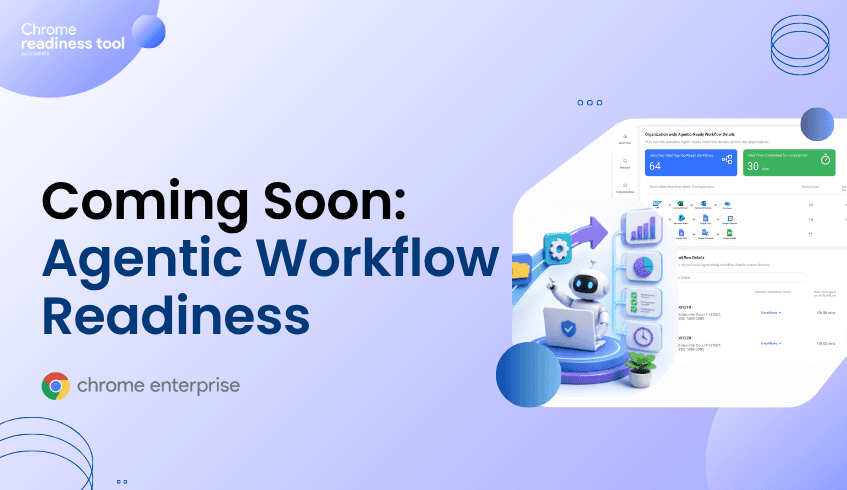
Summary Enterprise teams know repetitive work is slowing them down, but most organizations do not know which workflows should be automated first. Manual processes often span email, spreadsheets, documents, calendars, SaaS tools, and internal applications, making them hard to measure and even harder to prioritize. Agentic Workflow Readiness in Chrome Readiness Assessment helps close that gap by surfacing repetitive, multi-step workflows and identifying where AI-driven automation can create the most business value. It helps teams move from guessing about automation opportunities to planning with real usage insight. Why is workflow automation still difficult for enterprises? The problem is not a lack of automation tools. The problem is knowing where to apply them. Most enterprises already have teams experimenting with AI agents, workflow automation, scripts, and no-code tools. But without visibility into how work actually happens across devices and applications, automation becomes fragmented. One team may automate a task that saves minutes, while a larger, more repetitive process remains untouched. This creates several business pain points: Manual workflows continue to consume employee time. Operations teams struggle to identify high-impact automation opportunities. IT teams lack a clear view of which applications are involved in recurring workflows. Business leaders cannot easily estimate where automation will reduce cost or improve efficiency. Automation decisions are often based on assumptions instead of real usage patterns. As organizations move toward agentic AI, this visibility gap becomes more important. AI agents can automate complex work, but only when the organization understands which workflows are repeatable, frequent, and technically feasible to automate. How Chrome Readiness Assessment Helps Identify Automation Opportunities Chrome Readiness Assessment helps organizations move from uncertainty to visibility. Before teams invest in AI agents or automation platforms, they need to understand how work is actually happening across the enterprise. Which workflows are repeated every day? Which ones consume the most time? Which applications are involved? Which processes are good candidates for automation? The Agentic Workflow Readiness feature expands the value of Chrome Readiness Assessment by giving IT and business leaders a clearer view of repetitive, multi-step workflows across devices and applications. Instead of relying on manual interviews, assumptions, or scattered process documentation, CRA helps surface workflow patterns from real application usage. It identifies recurring sequences across desktop and browser-based activity, highlights time spent on those workflows, and shows which workflows may be ready for automation. This makes CRA a practical starting point for agentic AI adoption. With CRA, organizations can: Discover repetitive workflows across users and devices. Understand where employees spend time on manual processes. Identify high-impact workflows based on frequency and time spent. See whether workflows are better suited for Google Workspace Studio, n8n, or both. Prioritize automation opportunities before committing implementation resources.
The key benefit is clarity. CRA does not automate workflows directly. It helps organizations understand where automation can deliver value, which workflows are feasible, and which automation path may be most appropriate. That turns Chrome Readiness Assessment from a readiness tool into a strategic automation planning layer. It helps leaders answer the question that often blocks AI adoption: Where should we automate first? Where do Google Workspace Studio and n8n fit? Agentic Workflow Readiness does not automate workflows directly. It helps organizations identify and plan the right automation path. For workflows centered around Google Workspace applications such as Gmail, Drive, Calendar, and related Workspace activity, Google Workspace Studio is positioned as a natural automation path. Google describes Workspace Studio as a way to automate work with Gemini-powered workflows and create AI agents for Workspace processes. For workflows that span multiple applications, SaaS platforms, or integration-heavy environments, n8n can support broader workflow automation. n8n describes itself as a workflow automation platform that combines AI capabilities with business process automation and supports a large ecosystem of integrations. This distinction helps teams avoid a common automation mistake: choosing a tool first and searching for use cases later. Agentic Workflow Readiness reverses that approach. It starts with real workflow behavior, then helps map the workflow to a suitable automation option. Why does workflow visibility matter before adopting AI agents? AI agents are powerful, but they need the right operating context. Without workflow visibility, organizations may automate isolated tasks while missing the bigger process. They may also underestimate integration complexity, duplicate automation work across teams, or invest in automations that do not address meaningful business pain. Agentic Workflow Readiness helps create that missing context. It gives decision-makers a clearer understanding of how work moves across applications and where repeatable patterns exist. This is especially useful for: IT leaders evaluating where agentic automation should begin. Operations teams looking to reduce repetitive manual effort. Business leaders seeking cost optimization opportunities. Transformation teams building an AI automation roadmap. Security and governance stakeholders who need visibility before automation expands. The result is a more disciplined path to agentic AI adoption. Teams can identify what is ready, understand which workflows are worth prioritizing, and choose automation technologies with greater confidence. How does this reduce operational cost? Operational cost is not only about software spend. It is also about the time employees spend repeating the same multi-step processes every day. When repetitive workflows remain manual, organizations absorb hidden costs through slower execution, duplicated effort, avoidable handoffs, and inconsistent process quality. These costs are difficult to manage when leaders cannot see where the time is going. Agentic Workflow Readiness helps make those costs visible by showing where repetitive workflows exist and how much time they consume. That visibility allows teams to prioritize automation where it can reduce manual effort and improve process efficiency. The business impact is practical: Employees spend less time on repetitive coordination. Teams can focus automation resources on high-value workflows. Leaders gain a clearer view of where manual work is creating drag. IT can plan automation adoption with better evidence. Organizations can move toward agent-driven operations without relying on guesswork. What makes this different from a traditional workflow audit? Traditional workflow audits are often manual, slow, and incomplete. They rely on interviews, surveys, workshops, or process documentation that may not reflect how work actually happens. Agentic Workflow Readiness is designed to support a more usage-informed approach. It analyzes workflow patterns across desktop and browser-based activity, including web application usage, to identify repeatable sequences and automation opportunities. That makes it more practical for modern enterprises, where workflows often span local applications, browser-based SaaS tools, and Google Workspace applications. Instead of asking, “What do teams say they do every day?” organizations can begin asking, “Which workflows are repeatedly happening across our environment, and which ones are ready for automation?” What should organizations expect from this feature? Organizations should view Agentic Workflow Readiness as a planning and visibility capability for automation strategy. It is not a tool for automatically deploying agents. It is not real-time orchestration. It does not create custom workflows on behalf of users. Its role is to help administrators and decision-makers identify automation-ready workflows and understand where tools like Google Workspace Studio or n8n may fit. That makes it especially valuable at the beginning of an automation journey. Before scaling agentic AI, organizations need to know where automation makes sense. Agentic Workflow Readiness gives them a clearer way to make that decision. FAQ What is Agentic Workflow Readiness? Agentic Workflow Readiness is a Chrome Readiness Assessment feature that helps organizations identify repetitive workflows that may be suitable for AI-driven automation. Does Agentic Workflow Readiness automate workflows automatically? No. It helps identify and recommend automation opportunities, but it does not execute, deploy, or orchestrate workflows automatically. Which automation platforms does it help evaluate? It helps map automation opportunities to Google Workspace Studio for Google ecosystem workflows and n8n for cross-application or integration-heavy workflows. Who benefits most from this feature? IT admins, operations leaders, transformation teams, and business decision-makers benefit because the feature helps them prioritize automation based on real workflow patterns. Why is this important for agentic AI adoption? Agentic AI works best when organizations know which workflows are repetitive, valuable, and feasible to automate. Agentic Workflow Readiness helps provide that foundation. Closing CTA Manual work is often hidden inside everyday application usage. Agentic Workflow Readiness helps bring that work into view, so organizations can identify high-impact automation opportunities before investing time and resources into AI agents. Start by using Chrome Readiness Assessment to understand where repetitive workflows exist across your environment. Then use those insights to prioritize the workflows best suited for Google Workspace Studio, n8n, or future agentic automation initiatives.
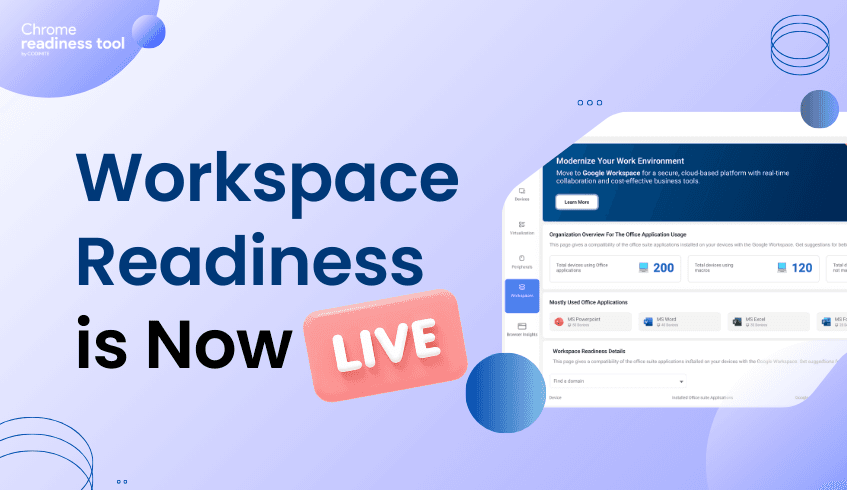
We are excited to announce that Workspace Readiness – Desktop version is now live in the Chrome Readiness Tool. This feature provides IT administrators with clear, data-driven visibility into how desktop installed office productivity applications are used across their organization.(Currently supported for Microsoft Office 365 and WPS only) Instead of relying on assumptions when planning cloud transitions, teams can now evaluate real usage data to determine readiness for Google Workspace.
As organizations continue adopting cloud-first strategies, reducing reliance on legacy desktop productivity software becomes an important step. However, moving away from established tools such as Microsoft Office requires careful planning. IT teams must understand application usage, technical dependencies, and potential compatibility issues before making the transition. Workspace Readiness – Desktop addresses this challenge by analyzing real-world application usage and highlighting where migration can proceed smoothly and where additional preparation may be required.
The feature begins with a high-level overview of desktop office suite applications usage across the organization. This allows administrators to understand the overall scale of dependency on legacy tools before initiating migration planning.
Key insights available at the organizational level include:
Office application usage overview Displays the total number of devices currently running office applications across the organization.
Macro dependency tracking Shows how many devices use macros and how many do not, helping teams quickly identify potential technical complexity.
Top application identification Highlights the five most widely used office applications, allowing compatibility planning to focus on the most important tools.
Beyond high-level metrics, Workspace Readiness – Desktop provides deeper device-level insights. These details help IT teams identify specific risks, understand application behavior, and uncover opportunities to optimize software usage.
The device-level view includes:
Installed versus used application analysis A visual comparison shows how many applications are installed versus how many are actively used, helping teams understand actual software requirements.
Unused application detection Applications that are not used at all by the user are automatically listed, allowing administrators to identify redundant software that may be removed.
Active usage metrics For applications that are actively used, the system shows total usage time in hours to help prioritize tools that employees rely on most.
Cloud transitions can sometimes stall due to technical limitations. Workspace Readiness – Desktop helps prevent this by identifying potential blockers early in the planning process.
The platform highlights several technical factors that may affect migration:
Macro usage detection Flags applications that use on macros, helping IT teams identify workflows that may require remediation.
Limitation indicators Displays potential compatibility file issues that could impact a migration to Google Workspace.
To simplify migration planning, the feature also maps legacy desktop applications to their Google Workspace equivalents.
Google Workspace suggestions Detected desktop applications are mapped directly to their corresponding Workspace tools, such as Microsoft Word, mapped to Google Docs.
Migration decision support These mappings help administrators quickly determine which users and applications are ready for transition.
With Workspace Readiness – Desktop version now available in the Chrome Readiness Tool, organizations can replace assumptions with real usage insights. By combining organizational visibility, device-level analysis, and clear technical indicators, IT teams can reduce migration risks, optimize software environments, and move toward Google Workspace with greater confidence.

MERGE operates at the intersection of health, wellness, marketing, and technology, helping purpose-driven brands turn complex ideas into meaningful experiences. As client expectations grow and timelines tighten, MERGE has focused on equipping its teams with tools that support innovation without slowing momentum.
Google Workspace has long been the foundation of how MERGE collaborates. From real-time meetings in Google Meet to shared documents in Docs and Slides and secure file access through Drive, the platform connects every stage of work into a single, cohesive environment. That cohesion enables teams to work together seamlessly, whether collaborating in real-time or asynchronously across different locations.
The introduction of Gemini for Google Workspace marked a turning point for MERGE. The company launched a 200-user pilot to explore how AI could fit into daily workflows. Adoption was immediate. Within days, Gemini became a natural part of how teams approached strategy, content creation, and client collaboration. Over the three-month pilot, MERGE achieved an 89 percent sustained usage rate.
Gemini is now the most-used application in MERGE’s Workspace environment, surpassing Docs and Sheets. Teams rely on it to summarize meetings with clear action items, accelerate recruiting content like job descriptions, and refine client-facing documents collaboratively in real time. This approach has led to a 33 percent improvement in turnaround times, helping MERGE respond faster in an industry where speed directly affects client outcomes.
Beyond productivity gains, Gemini has changed how MERGE teams collaborate. Meetings no longer require fully polished ideas before discussion. Instead, teams bring early concepts and work through them together, using Gemini to help align thinking and sharpen direction.
By removing friction from everyday tasks, Gemini allows MERGE employees to spend more time on creative and strategic work. Teams report higher engagement and stronger collaboration, reinforcing MERGE’s mission to amplify meaningful stories for health and wellness brands.
With Gemini now included in Workspace licensing, every employee has access to the same capabilities, supporting consistency and shared ways of working across teams.
You can read the full story from here - https://workspace.google.com/blog/customer-stories/google-workspace-gemini-allows-merge-build-innovative-effective-and-creative-team?e=48754805
MERGE’s experience highlights how quickly AI tools can become embedded in daily workflows. As Gemini becomes central to collaboration, content creation, and strategy development, organizations benefit from understanding where AI is used and how those workflows align with secure platforms.
The ChromeOS Readiness Tool addresses this need with its upcoming AI Application Highlights & Gemini Readiness feature. Integrated directly into existing dashboards and reports, it highlights AI applications actively used across the organization.
This visibility helps IT and transformation teams connect real usage patterns to ChromeOS planning. Instead of relying on assumptions, organizations can see how teams already use Gemini to collaborate, create, and deliver client work. AI Application Readiness also brings these insights into reporting, combining application usage, Gemini readiness, and ChromeOS compatibility in a single, actionable view.
MERGE shows how Gemini can strengthen collaboration, accelerate creative work, and support faster delivery when embedded into familiar tools. By integrating AI into everyday workflows, the company improved efficiency while deepening its collaborative culture.
With AI Application Highlights & Gemini Readiness coming to the ChromeOS Readiness Tool, other organizations can follow a similar path. They gain clarity into how AI supports real work and how Gemini-enabled workflows align with ChromeOS adoption. The result is informed, confident decisions that support creativity, governance, and long-term growth.
The future of enterprise efficiency is not only about having the right devices. It is about understanding how real work happens across your organization and spotting the moments where automation can create meaningful impact. Many teams want to adopt agentic workflows but struggle to identify where to begin. Most organizations lack visibility into the hidden routines, repetitive actions, and high-effort processes that consume employee time daily.
This is the core purpose behind introducing Agentic Readiness. We want to give IT leaders a clear way to see how work flows across applications and highlight the exact places where agentic automation can make a difference. Instead of guessing which tasks could benefit from automation, your dashboard will start revealing those opportunities for you. This update brings clarity, direction, and a practical starting point for any organization exploring Agentic-driven automation. With that foundation in place, we are excited to introduce a powerful new feature coming soon to your dashboard: the Agentic Workflow Assessment.
A Clear View of Real Workflows The Agentic Workflow Assessment brings visibility to the workflows happening across your enterprise devices. It provides the context you need before building any automation and gives you a starting point for identifying high-value opportunities. Once you see these workflows, you will have a clearer idea of which ones could be automated later using tools such as Google ADK, and n8n platforms.
What Insights Will You Gain? The upcoming dashboard upgrade provides a granular view of how work gets done in your organization. Here is what you can expect:
Visualize Real Workflows: Identify the most frequently used workflows and understand where employees are investing their time.
Map Application Dependencies: View all applications involved in each workflow and the sequence in which they are used.
Spot Critical Time Sinks: Workflows that exceed a total of 12 hours are marked as critical, making it easier to locate high-impact automation opportunities.
Defining Agentic Readiness The tool shows whether a workflow can be transformed into an agentic workflow using Innovative solutions available today, which are Google ADK and n8n. Workflows that meet this criteria are classified as Agentic Ready, helping teams understand where automation could drive measurable value.
Actionable Reporting All insights can be exported directly from the dashboard. These reports provide a full overview of your organization’s agentic readiness status, helping you plan and progress your automation journey with confidence. Stay tuned for this update to the ChromeOS Readiness Tool and get ready to uncover the hidden automation potential inside your enterprise.
Within the government IT landscape, efficiency, security, and cost-effectiveness are not merely aspirations, they are essential obligations. For the Douglas Omaha Technology Commission (DOTComm), supporting over 5,000 government workers across 120 locations was a logistical challenge that required a bold solution. By standardizing on Chrome Enterprise Browser, DOTComm didn't just simplify their infrastructure; they fundamentally transformed how Omaha and Douglas County serve their citizens.
DOTComm’s primary challenge was providing a reliable, secure way for employees to access files and stay connected, whether they were in the office or on the go. The solution lay in the browser. By deploying Chrome Enterprise Browser across their desktop and mobile fleets, DOTComm created a unified, secure workspace that travelled with the employee.
The impact on security was immediate. With Google Admin, the IT team could ensure that all downloads were automatically checked for malware, protecting sensitive government data without hindering user productivity. As Vijay Badal, Director of Application Services at DOTComm, noted, "As an IT department, we’re particularly pleased with the security and other IT benefits we get with Google... Chrome Browser and Google Workspace have allowed us to offer more secure and productive IT services."
The shift to a browser-first strategy produced staggering operational improvements. By centralizing management through the Chrome Enterprise Browser and Google Workspace, DOTComm achieved:
Reduced Support Volume: IT support tickets plummeted from 30 a day to just one or two, freeing up the helpdesk to focus on strategic initiatives rather than fires.
Leaner Operations: Infrastructure management headcount was reduced from six to one, allowing resources to be reallocated to development and innovation.
Cost Savings: The agency saved thousands of dollars in annual software licensing fees while simultaneously cutting hardware costs.
Faster Onboarding: New employees could be up and running faster and more cost-effectively than ever before.
DOTComm’s success with Chrome Enterprise Browser highlights the power of a cloud-first ecosystem. If you are inspired by these results and are considering taking the next step by migrating your devices to a full cloud-native operating system like ChromeOS or ChromeOS Flex, the ChromeOS Readiness Tool is your essential starting point.
The ChromeOS Readiness Tool is a free, private utility that helps organizations assess their technical readiness for a transition. It benefits your IT team by:
Identifying Compatible Devices: Instantly see which Windows devices in your fleet are eligible to be converted to ChromeOS or ChromeOS Flex.
Analyzing App Usage: Automatically inventory your applications to identify which are cloud-ready and which might require virtualization (VDI).
Generating Actionable Reports: Receive a detailed readiness report that allows you to plan a seamless, data-driven migration strategy without the guesswork.
Just as DOTComm standardized its browser experience to save costs and boost security, the ChromeOS Readiness Tool helps you determine how easily you can standardize your operating system to lock in those benefits for the long term. You can read the full story from here: https://chromeenterprise.google/customers/dotcomm-omaha-douglas-county/
Artificial intelligence is no longer experimental in the workplace. From writing assistance and design tools to copilots and generative platforms, AI applications are already shaping how employees work every day. In many organizations, this adoption has happened organically, often without centralized visibility or clear governance.
As enterprises plan their move to ChromeOS, understanding this AI usage landscape becomes just as important as evaluating devices and traditional applications. Without clarity into how AI tools are being used today, migration planning becomes more complex, and risk increases.
AI adoption is moving faster than most governance models. IT and security teams are frequently left asking fundamental questions. Which AI tools are installed across the organization? Where are they being used? Do they align with ChromeOS compatibility, security standards, and enterprise policies?
When these questions go unanswered, ChromeOS readiness assessments can stall. Migration decisions may rely on assumptions instead of data, security teams may lack visibility into unsanctioned AI usage, and organizations may miss opportunities to guide users toward approved, enterprise-grade AI platforms.
AI application visibility and readiness is no longer a future consideration. It is a present-day requirement for organizations that want to modernize their endpoint strategy responsibly.
Traditional readiness assessments focus on devices, operating systems, and conventional applications. While these remain critical, they do not capture the full picture of modern work.
AI tools often span cloud services, desktop applications, and browser-based workflows. They may be installed intentionally, introduced by individual teams, or adopted informally without IT involvement. This creates blind spots during migration planning and makes it difficult to balance innovation with control.
Without a structured way to assess AI usage, organizations risk carrying unmanaged complexity into their environments.
To address this growing challenge, the ChromeOS Readiness Tool is introducing an upcoming AI Application visibility capability.
This new feature is designed to bring AI usage into the same trusted assessment framework that organizations already rely on for ChromeOS migration planning. Instead of treating AI as an afterthought, it becomes a visible, measurable part of readiness discussions.
At a high level, AI Application visibility will help organizations:
Understand which AI tools are present across their environment
AI tool usage based on hours
See which AI applications are Gemini Ready
Support informed decisions around AI governance and standardization
Prepare for a future where Gemini plays a central role in enterprise AI workflows
AI is becoming a foundational layer of modern work, not a standalone capability. As this shift accelerates, readiness assessments must evolve alongside it.
The upcoming AI Application visibility feature in the ChromeOS Readiness Tool reflects this evolution. It provides a structured way to acknowledge existing AI behavior, address current gaps, and prepare for a more secure, intentional AI strategy on ChromeOS.
More details will be shared soon. This is the first step toward bringing clarity and confidence to AI-driven ChromeOS transformations.
For nearly a century, Blue Cross Blue Shield of North Carolina (BCBSNC) has been known for its commitment to quality, affordability, and community-focused healthcare. In today’s healthcare landscape, operational excellence depends not only on medical systems but also on the technology that supports secure access, fast workflows, and dependable digital experiences.
Like many enterprise organizations, BCBSNC faced a familiar challenge. Their teams were still relying on legacy browsers that slowed productivity and increased risk. The organization needed a modern browsing foundation that could support cloud applications, protect sensitive healthcare data, and deliver a consistent experience for thousands of employees.
This case study highlights how BCBSNC transformed its environment by selecting Chrome Enterprise Browser and how your organization can evaluate its own path toward a secure, cloud-first future.
BCBSNC identified that a large percentage of its workforce was still depending on Internet Explorer and Microsoft Edge in their older configurations. This created several operational pain points:
Update fatigue: IT teams were spending time and resources trying to keep legacy browsers updated, which created gaps in security posture.
Productivity slowdowns: Key applications responded inconsistently, and employees experienced delays that hurt daily workflows.
Heightened security risks: Older browsers lacked modern phishing protections, sandboxing, and real-time safeguards needed for sensitive healthcare information.
BCBSNC needed a browser that could support modern web standards while still giving employees access to critical legacy applications without disruption.
Instead of defaulting to the most well-known browser, BCBSNC conducted a structured evaluation. They compared six major browsers using eight decision categories, such as operating system compatibility, enterprise-grade security, accessibility capabilities, and strength of the extensions library.
Chrome Browser stood out due to both performance and ecosystem value. With Chrome Enterprise, BCBSNC gained powerful administrative controls through the Google Admin Console, letting the End User Computing team manage updates, enforce policies, and maintain consistent governance across their environment.
BCBSNC adopted a disciplined deployment model using Chrome release channels. This helped them achieve stability while still testing future updates early.
Beta Channel: Assigned to pilot users who verified application behavior on upcoming Chrome versions. This allowed the IT team to validate compatibility six weeks before public release and reduce surprises.
Stable Channel: Rolled out to the broader workforce. This channel delivered fully tested releases every 2 to 3 weeks and kept the environment predictable.
According to Nitin Kadam, Senior Enterprise Architect at BCBSNC, Chrome Enterprise strengthened its defenses through helpful warnings, phishing prevention, and advanced site protection features.
One of the most common concerns for any browser transformation is the fear that older applications might stop working. BCBSNC addressed this using Legacy Browser Support.
The outcome was remarkably positive. Out of roughly 1200 applications in their environment, only six required Legacy Browser Support. All six continued to function reliably, which gave BCBSNC confidence to modernize without interrupting mission-critical operations.
BCBSNC demonstrated that choosing Chrome Enterprise Browser can elevate security, accelerate development workflows, and raise productivity across large teams. Once your organization standardizes on a secure enterprise browser, the natural next step is to evaluate the devices that support your cloud first goals.
This is where the ChromeOS Readiness Tool becomes essential.
Organizations considering ChromeOS Flex often want clear insights on which devices in their current Windows fleet are compatible. The ChromeOS Readiness Tool provides those insights without guesswork.
Clear, data-driven assessments: The tool scans your existing devices and shows which ones qualify as Certified models that can transition smoothly to ChromeOS Flex.
Cost efficiency: Instead of replacing an entire fleet, you can extend the lifespan of devices that already meet requirements, reducing capital expenses.
Sustainability benefits: Repurposing hardware helps minimize e-waste and supports long-term environmental commitments.
By following the same principle that guided BCBSNC, you can use data to shape the next phase of your cloud-first journey. Chrome Enterprise Browser delivers a modern, secure browsing foundation, and the ChromeOS Readiness Tool helps you evaluate the hardware that will support your workforce in the future.
You can read the full case story here: